REVIEW · BERGEN
PRIVATE GUIDED TOUR: Secrets of the Fjords – the Osterfjord and Mo, 6-7 hours
Book on Viator →Operated by JANDIS AS · Bookable on Viator
Fewer cars, more fjord time. I like the private setup and I love how this day turns into waterfall country around the Osterfjord instead of just doing the usual quick pull-outs. You ride with a guide through secluded corners near Osterøy and learn what you’re seeing as you go.
One thing to plan for: it’s a car-and-views day, not a long hiking trip. You do have a short walk on a moderately steep trail at the Stone Age settlement stop, so bring shoes you’re comfortable in, especially in winter.
In This Review
- Key highlights to know before you go
- Why the Osterfjord and Mo feel more real than the average day trip
- Bergen pickup and a comfortable minivan for a full fjord circuit
- From Bergenhus Fortress to the Osterøy Bridge: your first fjord hit fast
- Dale of Norway: wool craft, museum context, and easy souvenir shopping
- Skipshelleren on Bolstadfjord: Stone Age remains with a real walk
- Hesjedalsfossen and the quiet thrill of narrow-fjord waterfall country
- Mo (Moo): lunch with a view between Geitaskaret and Kvernhusfossen
- Kvernhusfossen, Mostraumen, and the return across Nordhordlandsbrua
- The guide factor: live commentary that makes stops stick
- Timing, weather, and what to pack for a 6.5-hour fjord loop
- Price and value: what $1,317 per group buys you
- Who this Osterfjord and Mo tour suits best
- Should you book Secrets of the Fjords: the Osterfjord and Mo?
- FAQ
- How long is the Secrets of the Fjords tour?
- Is this tour truly private?
- Do you get pickup and drop-off in Bergen?
- What stops are included on the route?
- Is there an option to add a private fjord cruise?
- Do I need to pay for admissions at the stops?
- Will the tour work in bad weather, and how physically active is it?
- What languages can the guide speak?
- Is there free cancellation?
Key highlights to know before you go
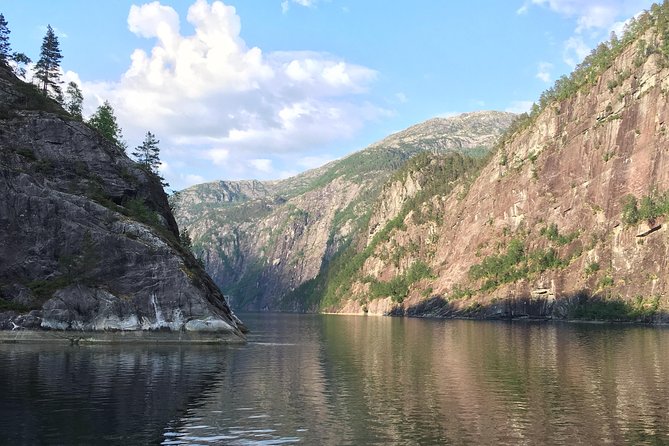
- True private touring: only your party, with door-to-door pickup from Bergen hotels or the cruise ship port
- Osterøy Bridge viewpoint: your first fjord look comes right after crossing, so you get momentum fast
- Waterfall stops that locals talk about: Hesjedalsfossen, Mo between waterfalls, and Kvernhusfossen
- Mostraumen strait timing by tide: a narrow channel where current can be strong and views stay dramatic
- A wool stop that’s more than shopping: Dale of Norway outlet and museum time to understand the craft
Why the Osterfjord and Mo feel more real than the average day trip
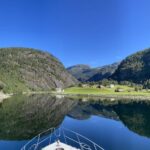
This is the kind of fjord tour that works because it doesn’t try to cram everything into a checklist. Instead, you focus on one region: the Osterfjord wrapping around Osterøy, plus the villages and side roads that sit quietly beyond Bergen’s main pull.
What I like about the approach is that you’re not just stopping for photos and immediately moving on. You get multiple viewpoints and short “pause” moments, plus a few cultural touches. Even if the scenery is the main draw, the guide’s job is to connect the dots—how these waterways shape daily life, why certain places became famous, and what you’re looking at when the fjord narrows or the waterfalls drop suddenly into it.
Mo (pronounced Moo) is a great example. The day isn’t only about famous waterfalls. It’s also about a small village setting between two waterfalls, with a lunch break that feels like local geography, not a staged stop.
You can also read our reviews of more tours and experiences in Bergen.
Bergen pickup and a comfortable minivan for a full fjord circuit
You start in Bergen, usually with an early morning departure around 9:00am. The big practical advantage is that pickup and drop-off are handled for you—so you don’t waste precious fjord time finding buses, parking, or transfers.
Transportation is by air-conditioned private minivan or car, depending on your group size. The tour is designed for a small group: up to 7 people per booking, and it’s private for your party. That matters because you can hear the guide’s live commentary without the noise level you get on crowded group tours.
Also, you’re not left guessing about logistics. You get a mobile ticket, and bottled water is included, which sounds minor until you’ve done a few days of Scandinavian walking and weather.
Two timing notes that help you enjoy the day:
- It’s about 6 hours 30 minutes total, so you’ll feel the rhythm of driving between stops.
- Some stops are short by design (a quick look, a short trail, a short waterfall view). Think of the day as a string of “high points,” not one long sightseeing loop where everything takes ages.
From Bergenhus Fortress to the Osterøy Bridge: your first fjord hit fast
Early on, you head out of central Bergen with the guide speaking as you drive. One of the first landmarks you pass is Bergenhus Fortress. It’s a classic piece of Bergen’s medieval story, and it’s a nice warm-up before you head toward the fjord world.
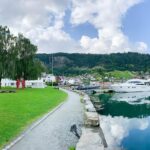
Right after that, you cross the Osterøy Bridge and stop at a viewpoint. This is a smart pacing choice: you don’t wait until mid-day to see the Osterfjord clearly. You get that “oh wow” moment early, while the light is often still good and your energy is high.
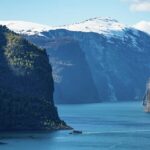
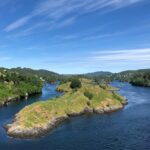
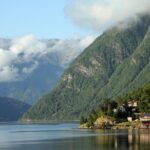
The Osterfjord itself is the core setting here. It wraps around Osterøy island, one of Europe’s large continental islands. From the bridge viewpoint, you can usually understand why this region feels so different from the open sea—fjords pull the eye inward, and the water shape makes the coastline look layered and deep.
Dale of Norway: wool craft, museum context, and easy souvenir shopping
After the first fjord stretch, you move back toward the mainland and head to Dale for a short stop at the Dale of Norway Factory Outlet & Museum.
This is one of those stops that can help your day’s theme. If you’ve been watching fjord water and steep terrain, it’s useful to see how people built their lives here—especially through textiles and wool production. The museum and outlet time is also practical: it’s a place where buying a warm sweater doesn’t feel like random tourist shopping. You get to connect the product to the place.
The stop is about 20 minutes, so don’t expect a slow museum day. Instead, think of it as a quick orientation and a chance to pick up something useful for the cold—like a hat, scarf, or sweater—if you want a real Norwegian-made item rather than a generic souvenir.
If you’re not into shopping, you can still use this as a reset: sit, warm up, and refocus before the waterfall-and-fjord side roads start.
Skipshelleren on Bolstadfjord: Stone Age remains with a real walk
Once you leave Dale, the route shifts onto lesser-known roads heading north. This is where the scenery starts feeling more “in motion” and less like standstill sightseeing—steep mountains, narrow fjords, and small settlements that don’t scream for attention.
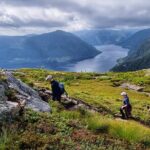
Your next stop is Skipshelleren, a Stone Age settlement on the Bolstadfjord. Plan for a short walk on a trail described as moderately steep. It’s not long, but it is physical enough that proper shoes matter, and it’s the kind of stop that makes sense only if you’re willing to take a few minutes on foot.
Why I think this stop is worth it: it adds time depth. When you’re standing in fjord country, it’s easy to assume this landscape is only about modern views and modern travel. But the presence of Stone Age remains is a reminder that people adapted to these water routes long before today’s tourism.
In winter, expect surfaces to be tricky. The tour operates in all weather conditions, so you’ll want layers and grip-ready footwear.
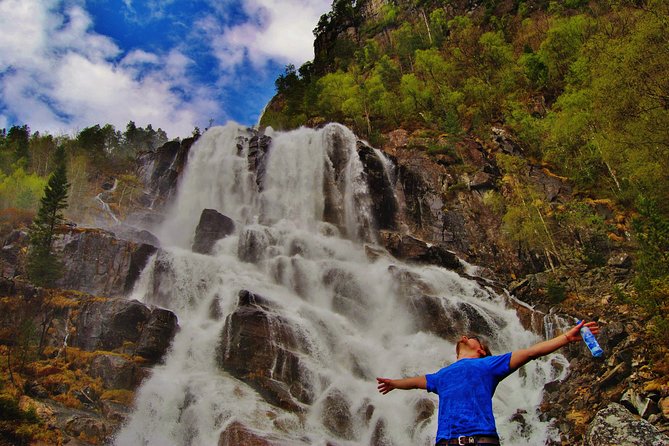
Hesjedalsfossen and the quiet thrill of narrow-fjord waterfall country
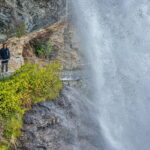
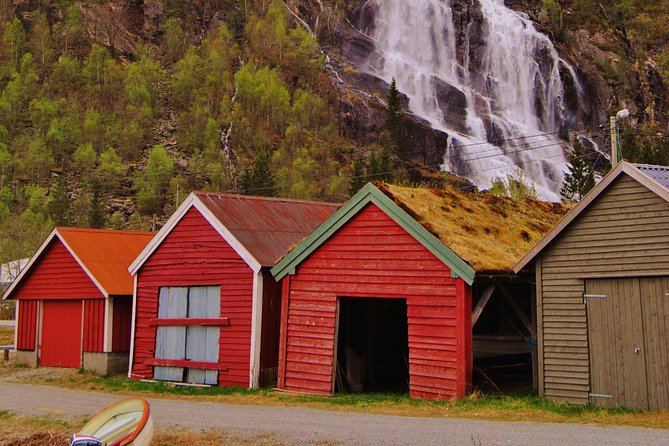
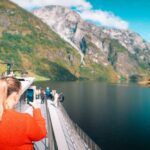
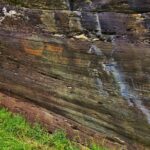
You’ll then make a stop at Hesjedalsfossen, one of the area’s iconic waterfalls. This is an easy stop to love because it hits the part of Norway that photographs well: narrow fjord framing, falling water, and a sense of steep terrain doing the work.
What makes it feel special in this itinerary is that it’s not presented as the only waterfall worth seeing. It’s one chapter in a sequence that includes other falls in different settings.
The stop itself is brief—about 10 minutes—so the goal is to get positioned, take a look, and let the guide explain what makes this one stand out. With time limits like this, you’ll get better value if you come prepared for cold and wet conditions (wind can be a bigger factor than you expect near water).
Mo (Moo): lunch with a view between Geitaskaret and Kvernhusfossen
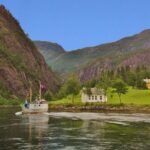
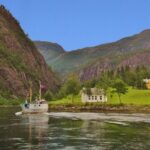
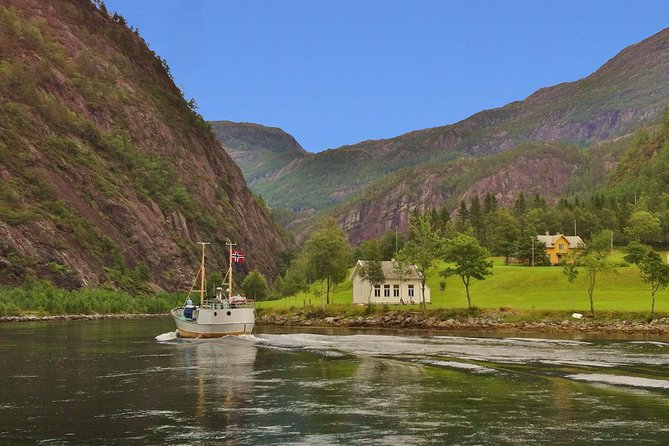
Next comes Mo, a cosy village set between two waterfalls: Geitaskaret and Kvernhusfossen. The tone of the day shifts here. Instead of only viewing from a roadside pull-off, you get a more village-like pause.
You have around 40 minutes for lunch at a small restaurant or café overlooking the Mofjord and Geitaskaret waterfall. This is a key part of why this tour works as a “secrets of the fjords” style day. You’re not rushing through everything. You’re giving your brain time to slow down—fjord views over a meal do that automatically.
If you’re traveling in winter, remember that waterfalls and fjords may be frozen. That can actually be a plus for photos and mood, but it also changes how you should dress and walk around. If you’re cold easily, this is the part of the day where you’ll want to bundle up before you sit outside or near open viewpoints.
Kvernhusfossen, Mostraumen, and the return across Nordhordlandsbrua
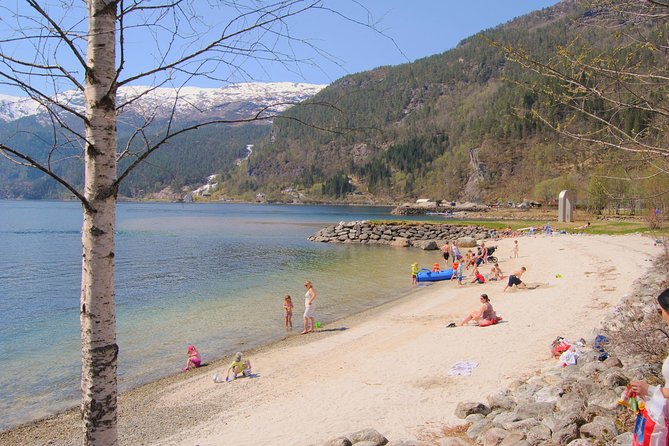
After Mo, you get one more waterfall stop at Kvernhusfossen (about 15 minutes). Even though Kvernhusfossen already shows up in the Mo area context, this is still a separate moment in the day—another angle, another frame, and another opportunity to compare what you’re seeing.
Then the itinerary moves toward Mostraumen, the 600-meter-long narrow channel connecting two fjords. Here, the guide’s explanation can matter just as much as the view, because during tide there can be strong current.
This stop is about 15 minutes, which means you’ll likely spend your time watching the water’s behavior rather than just staring at scenery. It’s a great “Norway works like this” lesson: narrow waterways speed up flow, and fjord geography isn’t only pretty—it’s functional.
On your way back, you continue along the Osterfjord west of Osterøy island, and you cross Nordhordlandsbrua, described as Norway’s second-longest bridge and part floating part suspension. Usually, there aren’t planned long stops here, so the value is the route itself—seeing the fjords from the bridge perspective while your tour comes full circle.
The guide factor: live commentary that makes stops stick
The tour includes live commentary during your drive, plus a driver-guide and local guide element. In practice, that means the day doesn’t feel like a sequence of random photo angles.
One name that stands out from feedback is Vlad. The comments are enthusiastic about his ability to take guests to more remote, local locations and to go above and beyond in how he paced the experience. Even if your guide isn’t Vlad, the lesson still applies: this tour’s quality is tied to guidance, not just transportation.
When you get a good guide in fjord country, you start noticing details you’d otherwise miss:
- where the fjord tightens and what that suggests about water movement
- why certain villages sit where they do
- how waterfalls carve and shape local terrain over time
Because the stops are mostly short, the guide’s explanations help you get more meaning per minute.
Timing, weather, and what to pack for a 6.5-hour fjord loop
This tour runs in all weather conditions, so you should dress for changing conditions rather than for a single forecast. Even in good weather, fjord air can cool down fast. If it’s raining, you’ll want a rain layer that doesn’t block your movement for the short trail walk.
Here’s what I’d prioritize based on the itinerary:
- Warm layers you can adjust quickly
- Waterproof shoes with grip (especially for the moderately steep trail at the Stone Age settlement)
- A light rain jacket or waterproof outer layer
- Sunglasses and camera protection, if it’s bright—water glare is real
In winter, plan for frozen waterfall scenes and potentially slippery ground. You won’t be alone with that challenge—the tour is designed for the conditions—but your comfort level will depend heavily on footwear and layering.
Also, don’t expect every waterfall stop to look identical across seasons. Frozen water can create dramatic shapes, but it can also change sound and flow. Either way, it’s worth showing up prepared so you can enjoy the differences.
Price and value: what $1,317 per group buys you
At $1,317.71 per group (up to 3), this isn’t a budget tour. But it’s also not priced like a “private tour only for the ultra-rich” when you think in practical terms.
What you’re paying for:
- Private transport in an air-conditioned vehicle
- Door-to-door pickup from Bergen hotels or the cruise ship port
- Live commentary and guided stops through multiple fjord areas
- A route that aims for quieter, more remote corners rather than only the most obvious viewpoints
If you split the cost among three people, the per-person value can become reasonable for a full half-day with a guide and dedicated driving time—especially if you’d otherwise need to piece together transport on your own.
One more point: the tour is booked on average 26 days in advance, which suggests it’s popular. If you’re traveling in peak season, it’s smart to lock it in early so you get your preferred day and guide availability.
Who this Osterfjord and Mo tour suits best
This tour is a strong fit if you want:
- Private fjord time without the friction of crowded buses
- A structured day (clear stops, short walks, planned lunch time)
- A mix of nature and local culture (waterfalls plus the Dale wool stop)
It’s less ideal if you want lots of long hikes or if you’re hoping for a walking-only day. The itinerary includes driving between stops, and the main active moment is the short moderately steep trail at Skipshelleren.
If you’re traveling as a couple, a small family, or a trio, the private format is the heart of the value.
Should you book Secrets of the Fjords: the Osterfjord and Mo?
I’d book this tour if your goal is a focused fjord day that feels personal—one vehicle, one group, and a guide who can explain what makes the Osterfjord region worth your time. The combination of Osterøy Bridge viewpoint, waterfall sequence (Hesjedalsfossen, Mo, Kvernhusfossen), and Mostraumen’s narrow-channel dynamics gives you a satisfying variety without turning the day into a marathon.
I would hesitate only if you dislike cold-weather walking (even brief and moderately steep) or if you want a slower pace with lots of time lingering at each stop.
If you want a practical, guided circuit through Western Norway that doesn’t rely on crowds, this is a very sensible choice.
FAQ
How long is the Secrets of the Fjords tour?
It runs about 6 hours 30 minutes (approx.).
Is this tour truly private?
Yes. It’s a private tour/activity where only your group participates. The booking maximum is up to 7 people per booking.
Do you get pickup and drop-off in Bergen?
Yes. Hotel or cruise ship port pickup and drop-off are included, and the tour starts from Bergen center or the cruise ship port area.
What stops are included on the route?
The itinerary includes Bergenhus Fortress, a viewpoint after Osterøy Bridge, Dale of Norway Factory Outlet & Museum, Skipshelleren (Stone Age settlement), Hesjedalsfossen waterfall, Mo village (lunch), Kvernhusfossen waterfall, Mostraumen strait, and then the return via Osterfjord and Nordhordlandsbrua.
Is there an option to add a private fjord cruise?
Yes, there’s an option to add on a private fjord cruise.
Do I need to pay for admissions at the stops?
The tour details show admission tickets as free for the listed stops.
Will the tour work in bad weather, and how physically active is it?
It operates in all weather conditions. You should have a moderate physical fitness level. There is a short walk on a moderately steep trail at the Stone Age settlement stop.
What languages can the guide speak?
The tour may be operated by a multi-lingual guide in English, Norwegian, and Russian.
Is there free cancellation?
Yes. You can cancel up to 24 hours in advance for a full refund.